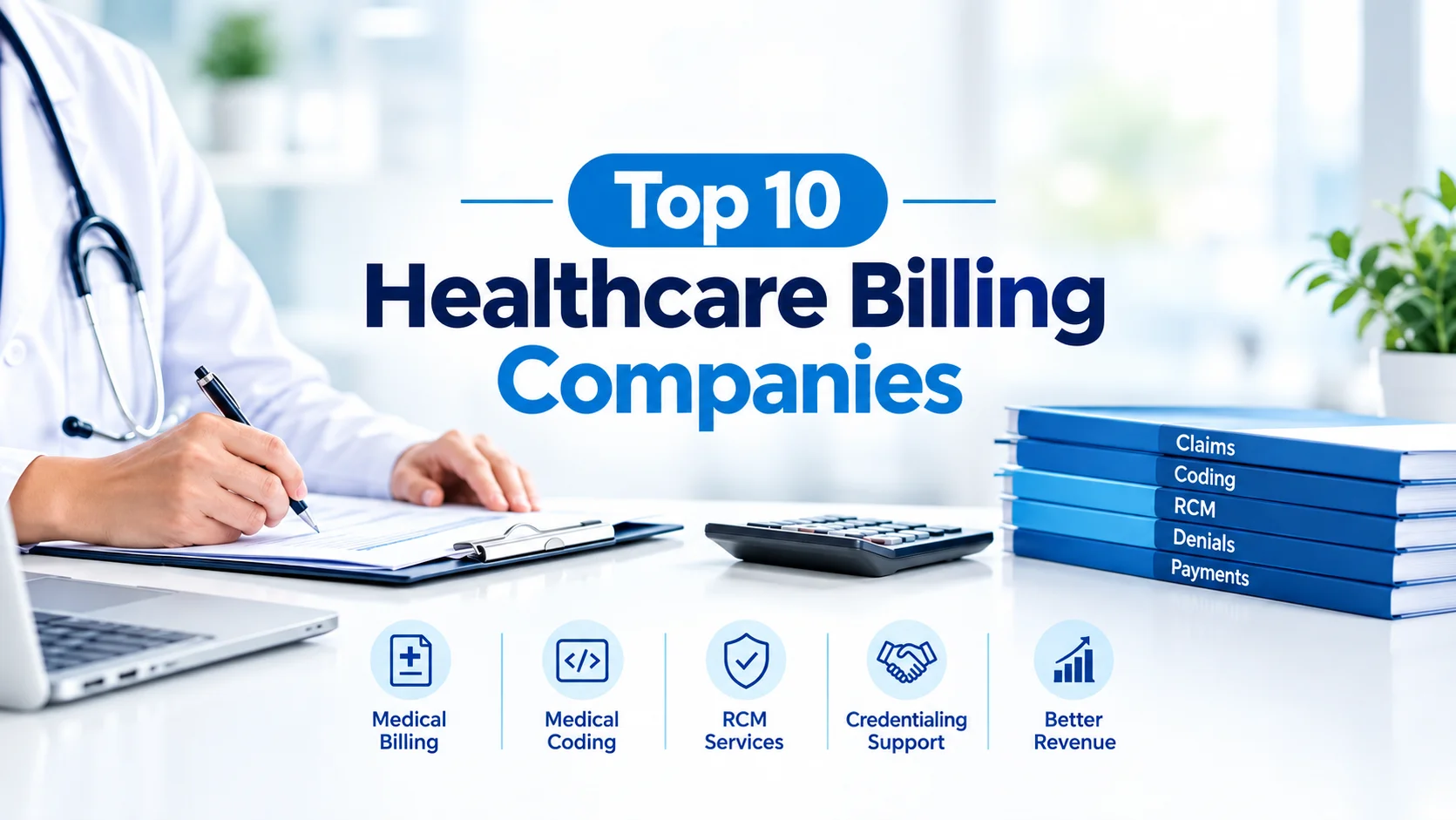
Are unpaid claims, billing errors, or time-consuming insurance follow-ups taking your team away from patient care? The right healthcare billing company can take much of that administrative burden off your staff while helping keep claims moving and revenue cycles on track.
To make your search easier, we’ve researched the top 10 healthcare billing companies and compared the services, specialties, technology, and revenue cycle management (RCM) solutions they offer. Whether you run a private practice, specialty clinic, or growing healthcare organization, this guide can help you understand your options and choose a billing partner that aligns with your practice’s needs.
The 2026 Medical Billing Landscape: Key Statistics Every Practice Should Know
Navigating commercial insurance carriers, Medicare Advantage guidelines, and evolving CMS reimbursement rules has made in-house billing increasingly complex. Recent medical revenue cycle data highlights why more healthcare providers are turning to specialized outsourcing:
- 11.8% Average Initial Denial Rate: The national average for initial claim denials hovers between 11% and 12%. Over 41% of U.S. practices report denial rates exceeding 10%, putting significant cash flow at risk.
- $25 to $118 Cost Per Claim Rework: Reworking a single rejected or denied claim costs an average of $25 in physician offices and up to $118 in hospital systems—erosing practice operating margins.
- 65% Abandonment Rate: Nearly two-thirds of denied medical claims are never resubmitted or appealed due to staff bandwidth limitations, leading to thousands of dollars in uncollected revenue every month.
- 30-Day A/R Benchmark: Top-performing medical practices maintain average Days in Accounts Receivable (A/R) below 30 days, whereas the industry average lingers around 42 to 45 days.
- 95%+ Clean Claim Target: Industry-leading RCM partners achieve a First-Pass Clean Claim Rate (FPCR) of 95% or higher, compared to the 80%–85% baseline typical of overburdened in-house billing teams.
Quick Comparison: Top 10 Healthcare Billing Companies at a Glance
The table below summarizes the top 10 billing providers based on target clinic size, key capabilities, technology model, and typical pricing structures.
| Medical Billing Company | Best For | Key Specialties & Strengths | Integration & Technology | Pricing Model |
| Medical Billing Services Texas (MBS Texas) | Independent & Specialty Practices in Texas & Regionally | Tailored RCM, Certified Coders, Dedicated Account Managers, Local Appeals Support | Integrates with major EHRs (Kareo, eCW, Epic, Practice Fusion) | Percentage of Net Collections (3%–7%) |
| athenahealth | Enterprise & Multi-Location Practices | Built-in Rules Engine, Deep Network Analytics, Patient Engagement Tools | Proprietary Cloud Platform (athenaOne) | Percentage of Collections |
| AdvancedMD | Mid-Sized & Growing Clinics | Custom Workflow Automation, Automated Pre-Bill Scrubbing, Telehealth | Full Cloud Suite (EHR + RCM) | Flexible / Tiered Monthly + % Options |
| CareCloud | Tech-Forward Specialty Clinics | AI-Driven Financial Dashboards, Patient Experience Management, RPM Billing | Proprietary Cloud Ecosystem | Percentage of Collections |
| DrChrono | Mobile-First & Specialty Providers | iPad/iOS Workflow Optimization, Customizable Charting, Direct Billing | All-in-One EHR & Medical Billing | Tiered Monthly Plans + % Option |
| Kareo (by Tebra) | Solo & Independent Small Practices | User-Friendly Interface, Transparent Billing, Independent Practice Focus | Cloud-Based Platform | Flat Monthly Fee or % Option |
| CureMD | Practices Needing MIPS/MACRA Support | AI Claim Scrubbing, Clinical Quality Reporting, Credentialing Services | All-in-One Cloud EHR & RCM | Percentage of Collections |
| NextGen Healthcare | Multi-Specialty Groups & FQHCs | Enterprise Reporting, Community Health Features, Specialty Content | Scalable Cloud & On-Premise EHR | Customized Enterprise Pricing |
| R1 RCM | Large Health Systems & Hospitals | End-to-End Enterprise RCM, Patient Financial Experience, Complex Claims | Agnostic API & Large EHR Connectors | Value-Based / Revenue Share |
| eClinicalWorks | High-Volume Clinics & ACOs | Data Analytics, Value-Based Care Integration, International Billing Capabilities | Native eCW Network + Third-Party Integration | Percentage of Collections |
Detailed Review of the Top 10 Healthcare Billing Companies in 2026
1. Medical Billing Services Texas (MBS Texas)
Best For: Independent medical practices, specialty clinics, and outpatient groups seeking a hands-on, dedicated RCM team.
Medical Billing Services Texas (MBS Texas) stands out by offering customized, high-touch revenue cycle management rather than treating clinics like an automated queue. While mega-corporations rely on distant call centers, MBS Texas pairs practices with certified medical coders (AAPC/AHIMA) and dedicated billing managers who know regional payer nuances, Texas Medicaid requirements, and commercial carrier policies inside out.
Key Features:
- Full-service revenue cycle management, including CPT, ICD-10, and HCPCS coding audits.
- Proactive denial management and direct insurance appeal workflows with documentation support.
- Real-time financial dashboards and transparent A/R aging reports (under 30-day A/R targets).
- Seamless integration with major EHR platforms without forcing software migrations.
- Comprehensive prior authorization, patient eligibility verification, and credentialing.
Why Choose MBS Texas?
If you want transparent reporting, a 95%+ first-pass clean claim rate, and a direct human contact who actively works to recover every dollar, MBS Texas provides the localized focus and accountability independent practices need to protect operating margins.
2. athenahealth
Best For: Medium to enterprise-level practices looking for an all-in-one network intelligence model.
athenahealth operates one of the largest healthcare data networks in the United States. Its billing service, athenaCollector, leverages collective intelligence from millions of claim submissions across its user base to automatically update claim rules whenever payers change guidelines.
Key Features:
- Automated claim scrubbing backed by nationwide payer rules.
- Patient billing portal with built-in online payment processing and automated reminders.
- Robust reporting metrics benchmarking practice performance against national peers.
Considerations:
athenahealth requires adopting its native cloud software ecosystem, which may require workflow adjustments for practices attached to their existing EHR.
3. AdvancedMD
Best For: Mid-sized, multi-specialty practices that want customizable automation tools.
AdvancedMD offers a comprehensive, cloud-based practice management and billing suite. Its platform gives practices deep control over billing workflows, making it popular with growing practices that need automated claim scrubbing alongside flexible scheduling and patient engagement systems.
Key Features:
- Advanced claim inspector that pre-scrubs claims against carrier-specific rules.
- Centralized dashboard tracking real-time claim status, unpaid balances, and denial reasons.
- Flexible EHR integration options alongside their native clinical platform.
Considerations:
The extensive feature set can carry a learning curve for smaller front-desk teams during initial onboarding.
4. CareCloud
Best For: Tech-focused practices looking for modern, AI-assisted practice dashboards.
CareCloud delivers a sleek, cloud-native revenue cycle solution designed to modernize front-desk operations and back-office billing. By pairing artificial intelligence tools with human billing specialists, CareCloud helps practices monitor revenue trends and address bottlenecks before they impact cash flow.
Key Features:
- Interactive analytics providing deep visibility into claim denial drivers and collector performance.
- Integrated digital front-desk tools for online scheduling, check-in, and co-pay collection.
- Support for specialized billing areas like Remote Patient Monitoring (RPM) and telehealth.
Considerations:
Contract terms and pricing structures vary based on modules selected, so review service-level agreements carefully.
5. DrChrono
Best For: Medical providers prioritizing mobile access, Mac/iPad native workflows, and custom clinical templates.
DrChrono combined EHR and medical billing onto mobile devices early on. Its billing services are directly integrated into its mobile-friendly practice management platform, making it a strong choice for boutique practices, mobile clinics, and tech-driven specialists.
Key Features:
- Direct claim submission from clinical encounter notes.
- Real-time eligibility checking directly inside the patient schedule.
- Custom medical coding rules tailored to specialty workflows (e.g., podiatry, orthopedics, dermatology).
Considerations:
Best suited for practices willing to utilize DrChrono as their primary EHR platform to get the most value out of the integrated billing service.
6. Kareo (by Tebra)
Best For: Independent solo practitioners and small private practices looking for simple, intuitive billing tools.
Now part of Tebra, Kareo built its reputation as an accessible, user-friendly billing platform tailored specifically to independent medical practices. It provides straightforward claim tracking, simple patient statement generation, and clean user interfaces.
Key Features:
- Intuitive billing workflow that simplifies entry, posting, and statement generation.
- Robust clearinghouse connections for direct claim submissions and ERA posting.
- Built-in messaging and digital billing statements to speed up patient collections.
Considerations:
While ideal for small to mid-sized practices, larger healthcare organizations or complex hospital-adjacent groups may require more advanced enterprise features.
7. CureMD
Best For: Practices seeking built-in regulatory support, MIPS/MACRA compliance, and automated billing.
CureMD delivers an integrated platform combining practice management, EHR, and full-service billing. It places a strong emphasis on regulatory compliance, helping practices satisfy CMS quality reporting programs while keeping claim denial rates low through automated scrubbing.
Key Features:
- AI-enhanced claim scrubbing that identifies coding mismatches before clearinghouse transmission.
- Built-in MIPS dashboard and quality metrics tracking.
- Dedicated denial management team handling appeals and complex carrier follow-ups.
Considerations:
System customization can require initial setup time to align with non-standard clinical workflows.
8. NextGen Healthcare
Best For: Multi-specialty groups, ambulatory surgery centers (ASCs), and Federally Qualified Health Centers (FQHCs).
NextGen Healthcare specializes in scaling RCM operations for larger, complex healthcare organizations. Their billing services handle the intricate requirements of multi-location clinics, community health centers, and practices managing diverse payer mixes.
Key Features:
- Tailored billing workflows designed for FQHC sliding-fee schedules and specialized grants.
- Comprehensive analytics engine tracking revenue across multiple practice locations and specialties.
- Integrated patient portal supporting flexible online payment arrangements.
Considerations:
The system’s scale and setup requirements make it better suited for larger organizations than solo or micro-practices.
9. R1 RCM
Best For: Large health systems, hospital networks, and large enterprise physician groups.
R1 RCM is an industry leader in enterprise-level revenue cycle management. Designed to manage end-to-end financial operations for major hospitals and multi-hospital networks, R1 focuses on driving systemic improvements across patient intake, clinical documentation improvement (CDI), and acute care billing.
Key Features:
- Comprehensive acute and ambulatory revenue cycle solutions.
- Proprietary technology that automates complex coverage discovery and prior authorization.
- Focus on total cost-to-collect reduction across large healthcare organizations.
Considerations:
R1 RCM is tailored specifically for enterprise health systems and is generally beyond the scope of independent medical practices.
10. eClinicalWorks
Best For: High-volume medical practices and ACOs needing extensive data integration and global support.
eClinicalWorks provides one of the most widely used health IT platforms nationwide. Its RCM service pairs native cloud software with back-office billing management, making it popular among high-volume clinics that want deep clinical data integration with their financial processing.
Key Features:
- Direct integration between clinical documentation, E&M coding tools, and claim filing.
- Advanced population health data analytics supporting value-based care contracts.
- Automated posting of Electronic Remittance Advice (ERA) to accelerate reconciliation.
Considerations:
Due to its large global footprint, support experiences can vary depending on your assigned account management structure.
Key Factors to Evaluate When Choosing a Medical Billing Service
Selecting the right revenue cycle partner directly impacts your practice’s financial stability. Here are five crucial areas to assess during your evaluation process:
1. First-Pass Clean Claim Rate & Denial Management
A claim submitted correctly the first time gets paid in days rather than months. Ask prospective billing partners for their verified First-Pass Clean Claim Rate (FPCR). Look for companies achieving 95% or higher. Furthermore, ask how they handle denied claims: Do they actively appeal clinical denials with documentation support, or do they simply send write-off requests back to your office?
2. EHR & Software Compatibility
If you are satisfied with your current Electronic Health Record (EHR) system, choose an RCM company that offers flexible integration. Partners like Medical Billing Services Texas (MBS Texas) work within your existing software—eliminating costly migration expenses, retraining periods, and operational disruptions.
3. Transparency in Accounts Receivable (A/R) & Reporting
Never hand over your billing without demanding total financial visibility. You should have 24/7 access to real-time financial reporting, including:
- Current A/R Aging (0–30, 31–60, 61–90, 90+ days).
- Net Collection Ratios (target should be 95%–98%).
- Top Denial Reason Codes (CARC/RARC analysis).
- Monthly payment posting vs. written-off adjustments.
4. Pricing Models: Percentage vs. Flat Rates
Most medical billing companies charge a percentage of net collections (typically ranging between 3% and 7% depending on practice specialty, claim volume, and average ticket size). This aligns incentives: they only get paid when you get paid. Avoid contracts with hidden fees for clearinghouse access, patient statement printing, or setup costs.
5. Specialty-Specific Coding & Compliance Expertise
General billing rules don’t always fit specialized medicine. Cardiology, orthopedic surgery, nephrology, and pain management each involve intricate CPT modifiers, unbundling rules, and strict prior authorization requirements. Verify that the company employs certified coders experienced in your specific discipline to avoid compliance audits and under-billing.
How Outsourcing RCM Improves Your Bottom Line (Financial ROI)
Outsourcing medical billing is often viewed as an added operational cost, but when executed correctly, it functions as a profit-driver that pays for itself.
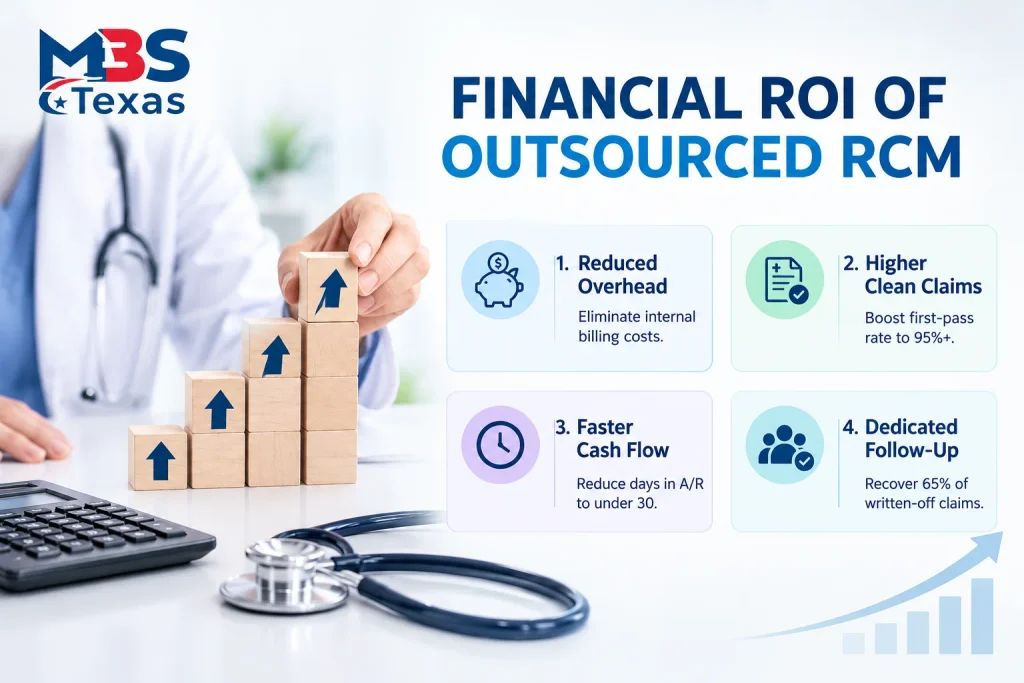
- Eliminating Overhead: Managing billing in-house requires paying salaries, health benefits, billing software user licenses, clearinghouse fees, and ongoing coding education. Outsourcing converts fixed payroll overhead into a variable expense tied directly to revenue.
- Accelerated Cash Flow: Professional RCM teams submit claims within 24–48 hours of encounter closure and conduct daily ERA reconciliation, reducing Days in A/R to under 30 days.
- Recovering Abandoned Claims: Because in-house staff are often overwhelmed with patient check-in and phones, denied claims often sit worked past timely filing limits. A dedicated RCM partner systematically appeals and recovers these lost dollars.
Ready to Optimize Your Practice’s Revenue Cycle?
Choosing the right healthcare billing partner is one of the most critical operational decisions your practice can make. Whether you need enterprise software integration or a dedicated local team that treats your revenue like their own, finding a partner aligned with your clinical goals allows you to focus on what matters most: delivering exceptional patient care.
At Medical Billing Services Texas (MBS Texas), we help practices eliminate billing headaches, lower denial rates, and collect full reimbursement for every service provided.
Frequently Asked Questions
What is a good clean claim rate for a medical billing company?
A best-in-class medical billing company should achieve a First-Pass Clean Claim Rate of 95% or higher. The national average for in-house billing hovers around 80%–85%. Achieving 95%+ clean submissions ensures consistent cash flow and minimizes administrative rework.
How much do medical billing companies charge in 2026?
Most medical billing services charge a percentage of net practice collections, usually between 3% and 7%. Factors influencing the rate include your practice’s monthly collection volume, medical specialty, average transaction size, and whether you require additional services like credentialing or prior authorization management.
Should I choose a nationwide billing corporation or a regional RCM provider?
Large nationwide corporations offer broad platform ecosystems, but they often route account management through automated ticketing systems or off-shore call centers. Regional specialists—such as Medical Billing Services Texas—provide dedicated account managers, deeper familiarity with local commercial payers and state Medicaid rules, and personal accountability.
What is the difference between an EHR billing module and a full-service RCM provider?
An EHR billing module is simply software that lets your staff enter charges and submit claims manually. A full-service RCM provider delivers human expertise: certified coders, billing specialists, and appeals experts who handle eligibility verification, claim scrubbing, payment posting, denial follow-ups, and patient collection calls on your behalf.
How quickly can outsourcing medical billing improve practice revenue?
Most practices see noticeable improvements in cash flow within 30 to 60 days of transitioning to an outsourced RCM partner. This acceleration occurs as clean claim rates rise, old outstanding A/R balances are systematically pursued, and billing backlogs are cleared.
Reviewed by the billing team at Medical Billing Services Texas (MBS Texas). Last updated October 2026.
AI tools helped with the first draft. Our team reviewed and edited it for accuracy.