If your medical practice administers injectables, infusions, or oral specialty drugs, you already know one hard truth. Drug claims are expensive, and payers scrutinize them ruthlessly. A single typo on a National Drug Code (NDC) or a miscalculated dosage unit can trigger a denial that ties up thousands of dollars in your revenue cycle.
Getting reimbursed for medications isn’t just about picking a code from a list. It involves a precise dance between the drug administered, the exact size of the vial you opened, and the method of delivery. Let’s break down exactly how medication HCPCS codes work, how to calculate your billing units without losing your mind, and the specific rules you need to follow to keep your cash flow healthy.
What Are Medication HCPCS Codes?
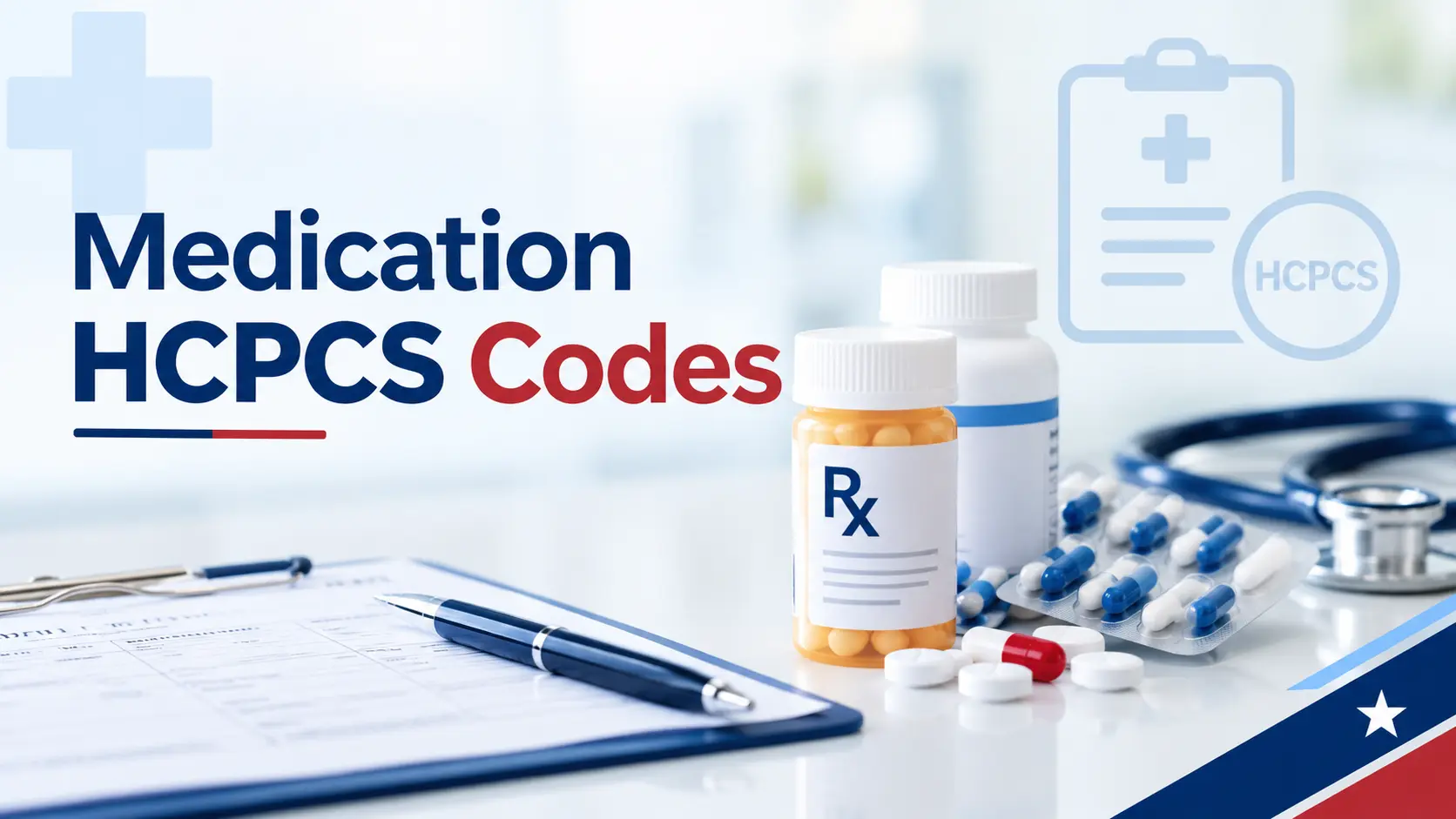
Healthcare Common Procedure Coding System (HCPCS) codes are alphanumeric codes used to report products, supplies, and services not included in the standard CPT manual. When it comes to medications, HCPCS Level II codes are the standard language used to tell Medicare, Medicaid, and commercial payers exactly which drug you pulled from your inventory.
Unlike a CPT code, which describes the action of the physician or nurse (like pushing an IV or performing a joint injection), the HCPCS code describes the physical substance itself.
Which HCPCS Code Ranges Cover Medications?
Medication codes are spread across a few different alphabetical sections of the HCPCS manual. Depending on what you prescribe, you will likely spend most of your time in these categories:
- J Codes (J0120-J9999): This is the massive category containing most non-orally administered medications, as well as chemotherapy drugs. If you inject it or infuse it, it probably has a J code.
- Q Codes (Q0000-Q9999): These are temporary codes. Medicare often assigns a Q code to a newly approved drug or biological before it gets a permanent J code.
- C Codes (C1000-C9999): You will mostly see these in the hospital outpatient setting (OPPS). They report drugs, biologicals, and devices used in outpatient facilities.
- S Codes (S0000-S9999): These are used specifically by commercial payers and Medicaid agencies. Medicare does not accept S codes. They often cover drugs or supplies that Medicare simply won’t pay for.
- The Oral J7/J8 Range: While most oral medications are handled through standard pharmacy benefits, certain oral anti-cancer drugs, anti-emetics, and immunosuppressives fall into the J8501-J8999 range.
- The Oddities (like H0034): Sometimes, codes describe the management of the medication rather than the drug itself. For example, H0034 is used by behavioral health providers for medication training and support.
Common Medication HCPCS Codes (Quick Reference Table)
Here is a quick look at some of the most frequently billed drug codes across various specialties, along with their billing units and typical usage.
| HCPCS Code | Drug Descriptor | Billing Unit | Typical Use |
| J1050 | Injection, medroxyprogesterone acetate | 1 mg | Obstetrics/Gynecology, contraception or hormone therapy |
| J1650 | Injection, enoxaparin sodium | 10 mg | Anticoagulant used to treat or prevent deep vein thrombosis |
| J1644 | Injection, heparin sodium | 1,000 units | General anticoagulant used in clinical settings |
| J7512 | Prednisone, immediate release or delayed release, oral | 1 mg | Immunosuppressive, often post-transplant |
| Q0144 | Azithromycin dihydrate, oral, capsules/powder | 1 gram | Antibiotic, often billed in specific outpatient programs |
| J3490 | Unclassified drugs | N/A | New or compound medications lacking a specific code |
HCPCS vs. CPT vs. NDC: How Drug Codes Differ
New billers often mix these three up. A clean claim requires all three coding systems working in harmony. If any of these contradict the others, the clearinghouse or payer will kick the claim back instantly.
| Code Type | What It Identifies | Example |
| HCPCS (Level II) | The specific medication or biological substance. | J1050 (medroxyprogesterone) |
| CPT (HCPCS Level I) | The physical work required to administer the drug. | 96372 (therapeutic, prophylactic, or diagnostic injection) |
| NDC | The exact manufacturer, drug strength, and package size. | 00009-0746-30 (a specific 150mg/mL vial from Pfizer) |
How to Read a Drug Descriptor and Calculate Billing Units
This is the single biggest trap in medical billing for injectables. The amount of medication you give the patient is rarely a 1-to-1 match with the number you put in the “units” box on your CMS-1500 form. You have to read the HCPCS descriptor carefully.
Let’s look at a concrete example using J1050.
The code descriptor for J1050 is “Injection, medroxyprogesterone acetate, 1 mg.” The billing unit is defined by the descriptor. In this case, 1 billing unit equals 1 mg.
If your provider administers a standard 150 mg dose, you do not bill “1 unit” just because you gave one shot. You have to divide the administered dose by the unit definition. You administered 150 mg, and each unit is 1 mg. Therefore, you will bill 150 units of J1050.
If the code descriptor was “per 10 mg,” and you gave 150 mg, you would bill 15 units. Always check the official HCPCS description before typing numbers into your billing software.
How to Bill a Medication Claim Step by Step
Submitting a flawless drug claim requires a highly specific sequence of information. Missing any of these elements will cause a delay.
- Select the Drug Code (HCPCS): Identify the correct J, Q, or C code for the medication.
- Select the Administration Code (CPT): Did the provider do a push? An infusion? A subcutaneous injection? Pick the matching CPT code (like 96365 for a prolonged IV infusion or 96372 for a simple injection).
- Format the NDC: Locate the exact National Drug Code on the vial. Convert it to the mandatory 11-digit format (usually by adding a zero to the appropriate segment).
- Calculate Your Units: Map the administered dose against the HCPCS unit descriptor.
- Assign the Diagnosis Pointer: Link the drug code directly to the ICD-10 diagnosis code that proves medical necessity. You cannot just bill for a drug; you must prove why the patient needed it.
- Apply Modifiers: Add wastage modifiers (JW/JZ) or laterality modifiers if required.
What Is an NDC-to-HCPCS Crosswalk, and Why Do Payers Require It?
You might wonder why you need to provide an NDC if you already provided a J-code. The answer comes down to money and fraud prevention.
Multiple pharmaceutical companies manufacture the exact same medication in dozens of different package sizes and concentrations. A J-code tells the insurance company what chemical the patient received, but it doesn’t tell them how much that specific vial cost you to buy.
An NDC-to-HCPCS crosswalk maps the exact 11-digit barcode on the packaging to the broad HCPCS category. Payers demand this crosswalk on the claim because reimbursement rates fluctuate wildly depending on the manufacturer. Without the NDC, the payer cannot verify the Average Sales Price (ASP) of the exact product you used.
JW and JZ Modifiers: Billing Drug Wastage Correctly
Medicare and commercial payers care deeply about what happens to the medication left over in single-dose vials. You actually get paid for the drug you throw in the trash, but only if you document it flawlessly using the JW and JZ modifiers.
- JW Modifier: Drug amount discarded/not administered to any patient.
- JZ Modifier: Zero drug amount discarded/not administered to any patient.
Let’s look at a math scenario that trips up a lot of practices. Assume you have a single-dose vial that contains a total of 400 mg of a drug. The HCPCS descriptor states that 1 unit equals 10 mg. The provider administers a 305 mg dose to the patient. The remaining 95 mg must be thrown away because it is a single-dose vial.
How do we bill this? First, we calculate the administered units. 305 mg divided by the 10 mg unit equals 30.5 units. CMS rules require us to round to the nearest whole unit for the administered amount, which gives us 31 units administered. Next, we figure out the total units in the vial. 400 mg divided by 10 mg equals 40 total units. If we billed 31 units, we have 9 units left over from that vial (40 total units – 31 billed units = 9 wasted units).
You will put this on the claim as two separate lines:
- Line 1: Drug Code, 31 units (Administered)
- Line 2: Drug Code with JW modifier, 9 units (Wasted)
If you use the entire vial with zero waste, you must append the JZ modifier to the single claim line. Payers will deny the claim outright if a single-dose vial is billed without either a JW or JZ modifier.
Unclassified Drug Codes (J3490, J3590, J9999): When and How to Use Them
Sometimes, a drug is so new that CMS hasn’t assigned it a specific alphanumeric code yet. In these cases, you are forced to use an unclassified code like J3490 (unclassified drugs), J3590 (unclassified biologicals), or J9999 (unclassified antineoplastic).
Billing these is a massive headache. Because the code itself is generic, you must provide heavy documentation in the electronic claim notes (Box 19 on a CMS-1500). You have to include the exact drug name, the NDC, the dosage given, and the route of administration. Many payers also require you to physically upload the vendor invoice so they can manually calculate your reimbursement based on your acquisition cost.
Medicare ASP Payment Limits and How Drugs Are Reimbursed
You don’t just get paid whatever you charge for a drug. Most Medicare Administrative Contractors (MACs) reimburse medications based on the Average Sales Price (ASP) methodology.
By law, CMS pays the ASP plus a small statutory percentage (historically +6%, though sequestration cuts often effectively reduce this). CMS gathers pricing data directly from manufacturers and publishes updated ASP pricing files every single quarter. If you are buying drugs at a premium from a secondary distributor, you might actually lose money on the administration if your acquisition cost exceeds the Medicare ASP limit.
Common Medication HCPCS Billing Errors and Denials
Even seasoned medical billers hate drug claims because the margin for error is essentially zero. The most common reasons payers deny these claims include:
- Missing or Mismatched NDCs: Providing a 10-digit NDC instead of formatting it to the mandatory 11-digit HIPAA standard format.
- Wrong Unit Counts: Billing the milligram dosage instead of dividing by the HCPCS unit definition. (Billing 1000 units instead of 1 unit).
- Missing Medical Necessity: The diagnosis pointer doesn’t support the use of the drug. Payers maintain strict Local Coverage Determinations (LCDs) listing exactly which ICD-10 codes justify which J-codes.
- Outdated Codes: Using a code that CMS deleted or replaced in the last quarterly update.
How Often Do Medication HCPCS Codes Change?
CMS doesn’t just update the HCPCS manual once a year. They issue quarterly updates in January, April, July, and October.
These updates can dramatically alter your billing templates. For example, the April 2024 update completely overhauled how practices bill for Depo-Medrol. CMS deleted three distinct methylprednisolone acetate codes and replaced them with a single, unified 1 mg code: J1010. Practices that failed to update their EHR templates in April saw massive waves of denials simply because they were submitting deleted codes.
Medication HCPCS Billing in Texas
If your clinic operates in Texas, you have specific regional hurdles to clear.
First, you are dealing with Texas Medicaid (TMHP), which has stringent rules regarding family planning injectables and behavioral health medication management. Second, your Medicare Part B claims run through Novitas Solutions (Jurisdiction H), which requires meticulous adherence to their specific LCDs for high-cost biologicals.
Commercial payers bring their own rules. BCBSTX, for instance, runs intense automated scrubbing on unlisted drug codes (J3490/J3590). If you submit an unlisted code to BCBSTX, their system aggressively checks the submitted NDC numbers and units to ensure you aren’t trying to slip an expensive experimental therapy past them. You must confirm all payer-specific rules against current Texas payer manuals before hitting submit, or you will face agonizing appeal timelines.
How a Medical Billing Service Texas (MBS Texas) Helps With Drug Claims
Managing drug inventory, keeping up with quarterly code deletions, and calculating JW wastage modifiers is exhausting. It pulls your staff away from patient care and forces them into data entry roles.
This is exactly where Medical Billing Services Texas(MBS Texas) changes the equation for local clinics. We build the complex NDC-to-HCPCS crosswalks into your software. We track the quarterly CMS updates so you never bill a deleted code, and we manage the rigorous documentation needed to get Novitas, TMHP, and BCBSTX to actually pay out on unlisted J-codes. We take the math and the liability off your plate so you can focus on practicing medicine.
Frequently Asked Questions
What happens if I forget the JZ modifier?
Your claim will be denied. Payers require the JZ modifier on all single-dose vials where no medication was discarded to confirm you didn’t just forget to report the waste.
Can I bill an unlisted J-code without an NDC?
No, this will trigger an automatic denial. Because unlisted codes do not describe a specific drug, the payer relies entirely on the NDC to determine what you administered and how much to pay you.
Do all payers require the NDC on a HCPCS claim?
Almost all do now. Medicare and Medicaid agencies mandate it, and virtually all major commercial carriers require the 11-digit NDC to process drug reimbursement.
What is the difference between J3490 and J3590?
J3490 is used for unclassified drugs (synthetic pharmaceuticals), while J3590 is specifically used for unclassified biologicals (products derived from living organisms, like certain vaccines or cell therapies).
How do I convert a 10-digit NDC to an 11-digit NDC?
You add a leading zero to whichever segment is short. The 11-digit format requires a 5-4-2 configuration. If your box shows a 4-4-2 format (e.g., 1234-5678-90), you add a zero to the beginning: 01234-5678-90.
Written and reviewed by the billing team at Medical Billing Services Texas (MBS Texas) | Last updated October 2026
AI tools helped with the first draft. Our team reviewed and edited it for accuracy.