What Is CPT Code 17110?
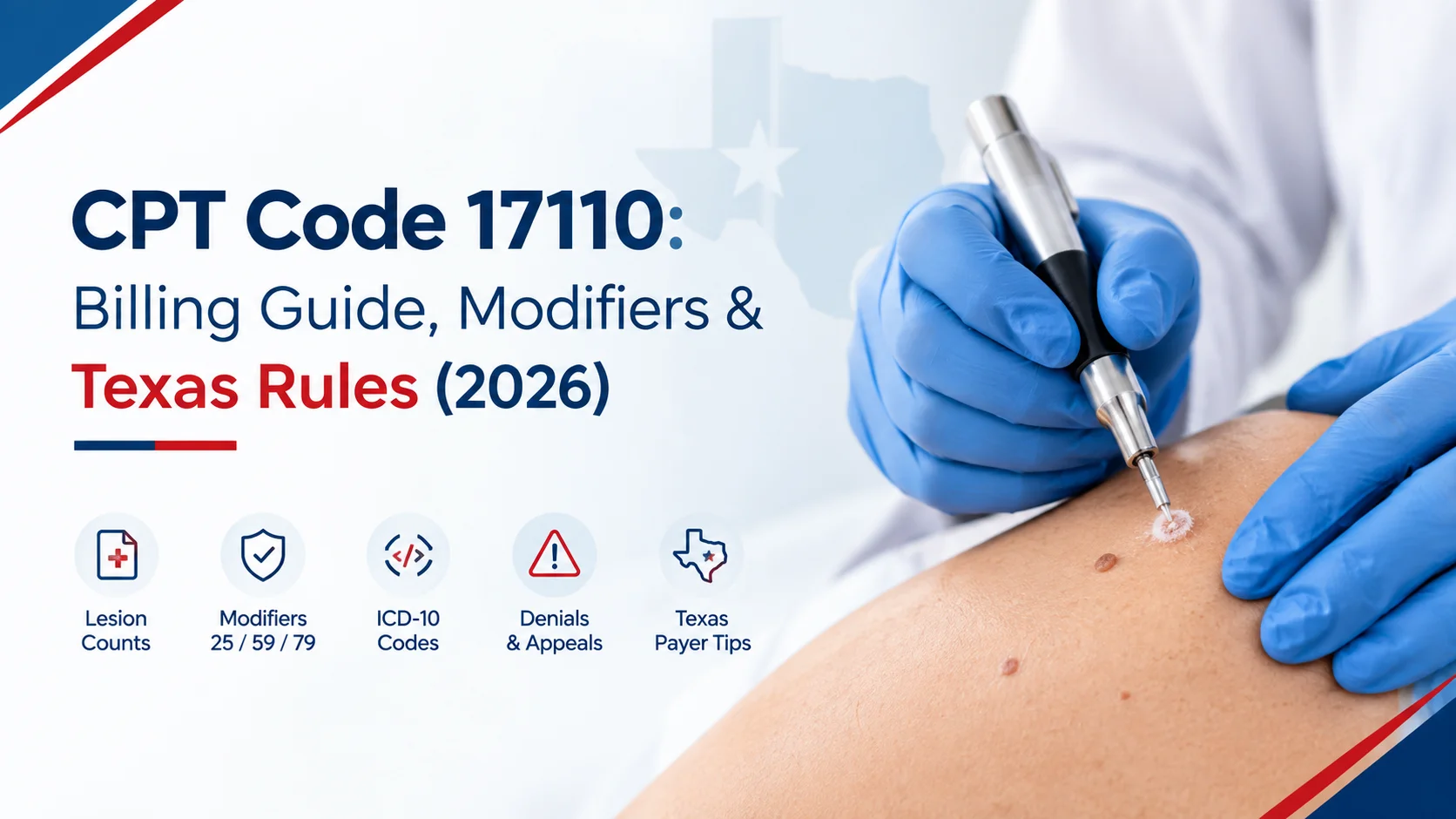
The official CPT descriptor for 17110 is: Destruction (e.g., laser surgery, electrosurgery, cryosurgery, chemosurgery, surgical curettement), of benign lesions other than skin tags or cutaneous vascular proliferative lesions; up to 14 lesions.
- Session-Based Definition: This code applies to the removal or destruction of between 1 and 14 benign skin growths per encounter, regardless of the specific destruction modality used (such as liquid nitrogen cryotherapy or electrocautery).
- Featured Snippet Answer: CPT code 17110 is a flat-fee minor surgery code used to report the destruction of 1 to 14 benign lesions (such as common warts or seborrheic keratoses) in a single patient encounter. Billed strictly as a single unit, it encompasses all destruction efforts performed during that session up to the 14-lesion ceiling.
CPT 17110 Description: Which Lesions Qualify and Which Don’t
Knowing what qualifies under this code keeps your practice safe from recurring audits.
- Qualifying Lesions: Common warts (verruca vulgaris), plantar warts, flat warts, seborrheic keratoses (SKs), molluscum contagiosum, and milia.
- Explicit Exclusions: Skin tags (which have their own dedicated code family), premalignant lesions like actinic keratoses (which belong under the 17000 series), and vascular lesions or cutaneous hemangiomas.
CPT 17110 vs 17111: Choosing by Lesion Count
Differentiating between 17110 and 17111 depends entirely on how many growths leave the clinic treated. The method of removal never dictates the code selection; the tally does.
| CPT Code | Lesion Count Range | Billing Rule | Mutually Exclusive? |
| 17110 | 1 to 14 lesions | Always billed as 1 unit | Cannot be combined with 17111 |
| 17111 | 15 or more lesions | Always billed as 1 unit | Cannot be combined with 17110 |
Why They Can’t Be Billed Together: CPT 17110 and 17111 are mutually exclusive. If a provider treats 18 lesions, you report 17111 alone. Stacking them together for the same patient session triggers an automatic bundling denial that modifiers cannot bypass.
How to Bill CPT 17110: One Unit Per Session
The most frequent error in billing 17110 involves the unit box.
- The Unit Box Rule: Regardless of whether the provider treats 1 wart or 14 distinct seborrheic keratoses, you enter “1” in the unit field.
- The Most Common Denial Cause: Putting “5” in the units box because the provider removed 5 warts. Payers view this as an invalid unit error, immediately rejecting the claim under National Correct Coding Initiative (NCCI) guidelines.
Related Destruction Codes: 17000, 17003, 11200, 11201, 17100
Establishing strong semantic coverage across related minor procedure codes protects your revenue cycle from miscoding:
| CPT Code | Primary Use Case | Target Lesion Type |
| 17000 | First premalignant lesion | Actinic Keratoses (AKs) |
| 17003 | Add-on code for lesions 2 through 14 | Actinic Keratoses |
| 11200 | Removal up to 15 lesions | Skin Tags (Acrochorda) |
| 11201 | Each additional block of 10 tags | Skin Tags |
| 17100 | Outdated or alternative localized destruction | Benign lesions ( historically referenced) |
Modifiers for CPT 17110 (25, 59, 79)
Uncomplicated destruction encounters go out clean with no modifiers attached. However, specific clinical footprints require deliberate modifier selection:
- Modifier 25: Appended to a same-day Evaluation and Management (E/M) service (e.g., 99213-25) when the physician performs a distinct, significant evaluation that leads to the decision to perform the destruction.
- Modifier 59 (or XS): Used when a separate procedure—such as nail debridement or callous paring—is performed on a distinct anatomical site during the same visit to bypass NCCI edits.
- Modifier 79: Applied if a benign lesion destruction happens during the global period of an unrelated procedure performed by the same physician.
CPT 17110 Global Period
- 10-Day Global Window: CPT 17110 carries a minor surgical 10-day global period.
- Impact on Follow-ups: Routine postoperative care, suture or crust checks, and localized healing assessments within those 10 days are bundled into the primary fee. You cannot bill separate office visits for routine check-ins on those same sites.
ICD-10 Codes That Support CPT 17110
Payers require an explicit diagnosis proving medical necessity, rather than aesthetic preference.
| Common Diagnosis | ICD-10 Code | Clinical Context |
| Common warts | B07.0 | Verruca vulgaris causing friction or pain |
| Seborrheic keratosis | L82.0 / L82.1 | Inflamed, bleeding, or irritated SKs |
| Molluscum contagiosum | B08.1 | Widespread viral skin papules |
| Milia | L72.0 | Small benign epidermal cysts |
- The Cosmetic Denial Trap: Avoid pairing 17110 with codes like Z41.1 (encounter for cosmetic surgery). Commercial carriers and Medicare will automatically issue a hard denial for routine aesthetic removals unless physical symptoms are documented.
Medical Necessity and Documentation Requirements
To defend your claims against post-payment audits, clinical notes should feature a robust medical necessity checklist:
- Lesion Count: Exact number of growths destroyed (e.g., “7 lesions treated”).
- Anatomical Locations: Specific body sites (e.g., “left dorsal hand, right forearm”).
- Destruction Method: Technique utilized (e.g., “cryotherapy using liquid nitrogen for 10 seconds per lesion”).
- Qualifying Symptoms: Documenting physical complaints, such as chronic bleeding from clothing friction, persistent pain, or secondary inflammation, rather than pure cosmetic concern.
CPT 17110 Billing Examples
- Scenario A (Clean 17110): A patient presents with 5 painful common warts on the fingers. The physician performs cryotherapy on all 5.
Billing: CPT 17110 (1 unit), linked to B07.0. No modifier required.
- Scenario B (The Limit Test): A patient undergoes destruction of 12 seborrheic keratoses on the back that bleed when rubbed by shirt collars.
Billing: CPT 17110 (1 unit). Do not bill 12 units or switch to 17111 (which starts at 15).
- Scenario C (Mixed Lesion Types): A patient has 3 warts and 2 skin tags treated.
Billing: Report CPT 17110 (1 unit) for the 3 warts, and CPT 11200 for the skin tags, ensuring skin tags are never blended under the 17110 count.
CPT 17110 Reimbursement and Medicare Coverage
- Payment Factors: Reimbursement varies based on non-facility versus facility settings, geographic wage indices, and individual commercial contracts. National non-facility Medicare averages hover around $70 to $110.
- Medicare Guidelines: Governed by localized medical review policies (LCDs and Articles, such as CMS Local Coverage Article A57482), Medicare covers destruction strictly when lesions are symptomatic, bleeding, or functionally compromised.
CPT 17110 Billing in Texas: Medicare, Medicaid & Commercial Payers
For Texas dermatology and primary care practices, regional MAC and payer policies dictate claim processing workflows:
- Novitas Solutions: As the Part B Medicare Administrative Contractor (MAC) for Texas, Novitas enforces strict documentation rules under its local skin lesion removal guidelines. Review their active billing policies to ensure precise symptom documentation.
- Texas Medicaid: Enforces strict coverage limitations, generally requiring clear documentation of functional impairment, pain, or recurrent infection. Purely aesthetic removals are non-covered.
- Commercial Payers (e.g., BCBS of Texas, Aetna, UnitedHealthcare): Most commercial plans align with CPT/AMA definitions, allowing 1–14 lesions under 17110, but may require prior authorization if performed in an ambulatory surgery center (ASC) setting rather than an office suite.
Common CPT 17110 Denials and How to Fix Them
| Denial Reason | Root Cause | How to Fix It |
| Invalid Units Error | Entering the exact lesion count (e.g., 8 units) instead of 1 unit. | Correct the claim to reflect exactly 1 unit and resubmit. |
| Clinical Mismatch | Pairing 17110 with an actinic keratosis (L57.0) or skin tag code. | Update diagnosis to match benign codes (B07.0, L82.0) or shift to the 17000 series. |
| Cosmetic Exclusion | Missing documentation of physical irritation or bleeding in the chart note. | Appeal with an addendum detailing physical symptoms (pain, bleeding) if clinically present. |
CPT 17110 Billing Best Practices for Dermatology Practices
- Charge-Capture Prompts: Embed EHR templates that force providers to input lesion counts and specific symptoms before closing the encounter note.
- Pre-Bill Audits: Run weekly scrub reports to catch multiple-unit submissions on 17110 before claims hit clearinghouses.
- Annual Code Updates: Keep billing teams educated on shifting local coverage determinations and relative value unit (RVU) adjustments.
How Medical Billing Services Texas Can Help With Dermatology Billing
Navigating complex local MAC edits, Novitas guidelines, and commercial payer nuances can strain internal clinic resources. At Medical Billing Services Texas(MBS Texas), we specialize in optimizing revenue cycles for dermatology and medical practices across the Lone Star State. From eliminating unit-entry errors on minor procedure codes like CPT 17110 to managing aggressive accounts receivable follow-ups, our experts ensure your practice captures every earned dollar cleanly and compliantly.
Frequently Asked Questions
Is CPT 17110 billed per lesion?
No. CPT 17110 is a session-based flat code covering anywhere from 1 to 14 lesions. You always report 1 unit regardless of whether you treat 2 growths or 12.
Can you bill 17110 for skin tags?
No. Skin tags are explicitly excluded from CPT 17110. Skin tags must be reported using code 11200 (up to 15 tags) or 11201 for additional blocks.
Can you bill an E/M with 17110?
Yes, but only if the provider performs a significant, separately identifiable evaluation and management service on the same day. You must append Modifier 25 to the E/M code.
What is the difference between 17110 and 17111?
The core difference is the lesion count. CPT 17110 covers 1 to 14 benign lesions, while CPT 17111 covers 15 or more.
Does CPT 17110 have a global period?
Yes, it carries a 10-day global surgical period. Routine post-treatment checkups within those 10 days are included in the initial procedure fee.
Does Medicare cover CPT 17110?
Medicare covers CPT 17110 only when medical necessity is established, such as when lesions are symptomatic, inflamed, bleeding, or causing functional discomfort, rather than for aesthetic enhancement.
Reviewed by the billing team at Medical Billing Services Texas (MBS Texas). Last updated October 2026.
AI tools helped with the first draft. Our team reviewed and edited it for accuracy.